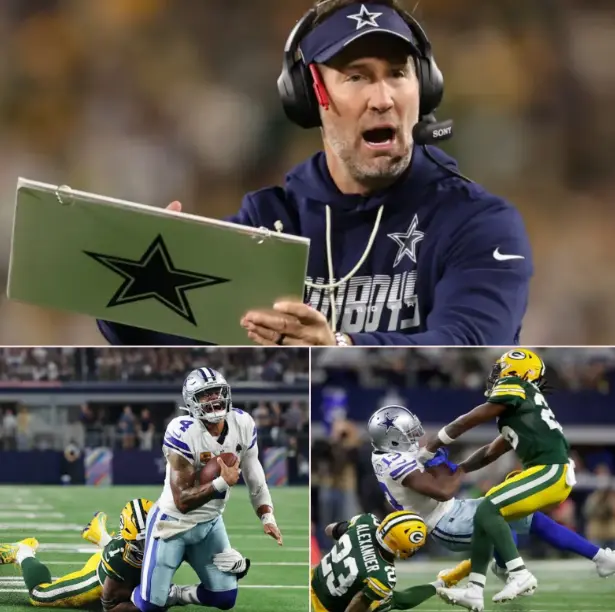
Dallas’ 13–23 loss to Green Bay has fueled a storm of debate over discipline, officiating, and the fine line between hard-nosed football and dangerous play. But did the controversy on the field cross a line that the NFL can no longer afford to ignore?

The final score told one story. The emotions surrounding the game told another.
The Dallas Cowboys walked away from their 13–23 defeat to the Green Bay Packers with plenty to review on film, from missed opportunities to the moments that allowed their opponents to take control. Yet the conversation surrounding the matchup has extended beyond the scoreboard, with questions about physical play, player conduct, and whether the rules are being applied consistently.
A fiery statement circulating online captures the frustration at the center of that debate. Its central accusation is blunt: when a player abandons a legitimate attempt to make a play and lunges at an opponent out of frustration, the action should not simply be dismissed as part of football’s physical nature.
“That hit? One hundred percent deliberate,” the statement declares.
The language is explosive, and it is certain to resonate with fans who believe dangerous contact deserves serious scrutiny. But there is an important distinction between an impassioned account of an incident and an established finding about a player's intent. The statement's authorship and the specific play it describes have not been independently verified here, so the accusation should not be treated as an official determination.
Still, the broader issue it raises is one the NFL cannot easily sidestep: where should the league draw the line between aggressive competition and conduct that puts players at unnecessary risk?
A GAME THAT GREW MORE PHYSICAL — AND MORE CONTENTIOUS

The tension was not entirely imagined. The game featured a substantial number of penalties, including flags for taunting and roughing the passer, highlighting how difficult it can be for players to maintain discipline in a high-pressure contest.
Both teams were penalized 11 times. Dallas accumulated 108 penalty yards, while Green Bay was charged with 96. The Packers were assessed five personal fouls, including two for taunting and three for roughing the passer, according to the team's postgame recap.
Those numbers provide context for the debate, although they do not independently establish that a particular hit was intentional or that officials deliberately overlooked misconduct.
In a sport built around speed, physical contact, and split-second decisions, distinguishing an aggressive football play from an unnecessary act can be complicated. Officials must judge what happens in real time, while video review and league discipline procedures may provide additional opportunities to examine certain incidents.
That does not mean every questionable play should escape scrutiny. Rather, it reinforces why specific evidence matters. The relevant questions include what happened before the contact, whether the player was pursuing the ball, where the contact occurred, and whether the action violated an applicable rule.
Fans can disagree about a call. Coaches can demand accountability. Players can express frustration. But establishing intent requires more than an emotional reaction to a replay.
For a league that consistently emphasizes player safety, consistency in enforcement is essential to maintaining credibility.
THE SCOREBOARD STILL TELLS A TROUBLING STORY FOR DALLAS
While the alleged controversy has attracted attention, the Cowboys also have substantial football problems to solve.
Dallas entered halftime trailing 17–0 after Prescott threw two interceptions. Green Bay capitalized on those mistakes and controlled the pace of the game, forcing the Cowboys to chase the score for much of the night.
The Cowboys showed some improvement after halftime. Javonte Williams scored on a one-yard run in the third quarter, and Ryan Flournoy caught a late touchdown pass that cut the deficit to 10 points. But Green Bay's defense held firm when the game was on the line, and Dallas could not complete its comeback.
The loss exposed familiar concerns: turnovers, an ineffective running game, and difficulties sustaining drives against a defense capable of applying pressure.
Those issues deserve at least as much attention as any disputed moment. Even if the Cowboys believe a particular call should have gone differently, they still need to limit their own mistakes and take advantage of scoring opportunities.
The Packers, meanwhile, demonstrated how a team can turn early momentum into a winning performance. Jordan Love threw for 276 yards and a touchdown, added a rushing score, and helped Green Bay improve to 4–2. Dallas fell to 2–4.
For the Cowboys, the challenge is not simply responding to criticism. It is producing a better performance the next time they take the field.
A MESSAGE ABOUT ACCOUNTABILITY — BUT WHO ACTUALLY SAID IT?
The statement circulating online closes with a message of support for the Cowboys' players, praising their effort, composure, and determination to keep fighting despite the score.
Its tone is unmistakably defiant. It portrays the defeat as a setback rather than a verdict on the team's character, while calling for greater consistency from those responsible for overseeing the game.
That is an understandable sentiment after a frustrating loss. Yet the statement should not automatically be attributed to a coach, owner, or player without a reliable source confirming its origin. Nor should its allegations be presented as established facts simply because the language sounds like a postgame press conference.
The distinction matters, particularly when a statement accuses players of deliberate misconduct or suggests that officials tolerated dangerous behavior.
What is documented is that Dallas lost 23–13 in a penalty-filled game. The specific accusations in the circulating statement require separate verification.
THE NFL FACES A QUESTION THAT GOES BEYOND ONE GAME
The broader debate is bigger than Dallas or Green Bay.
Football is supposed to be physical. Players are expected to compete aggressively, protect the ball, make tackles, and fight for every yard. But competitiveness does not eliminate the responsibility to follow the rules and respect opponents.
When an incident raises legitimate questions about unnecessary contact, the appropriate response is a careful examination of the available evidence. If a violation is established, the rules should be enforced consistently, regardless of the teams involved or the consequences for the final score.
That standard protects players and strengthens confidence in the game.
For the Cowboys, the immediate task is to review the defeat, correct their mistakes, and prepare for the next challenge. For fans, the questions surrounding officiating and player conduct are unlikely to disappear simply because the final whistle has blown.
And for the NFL, the message is straightforward: player safety and fair competition must be more than slogans repeated after a controversial night.
Dallas may have lost 23–13, but the debate over discipline, accountability, and the limits of physical football is far from over.
Editorial note: The 23–13 result and game statistics are supported by published game reports. The opening quotation and allegations of a deliberate hit have not been independently authenticated and should not be treated as a verified statement from a named team representative.